A Message from the Co-Chairs

Executive Chair

Co-Chair
Why MaternalMinds, Why Now?
Every generation has an opportunity to redefine how society cares for mothers.
Over the past century, remarkable advances in obstetric and neonatal care have transformed pregnancy and childbirth. Better maternity services, safer surgery, improved management of haemorrhage, hypertension and infection, together with advances in neonatal care, have dramatically reduced deaths from the traditional physical complications of pregnancy.
That success is one of modern medicine’s greatest achievements.
But it has also changed the challenge before us.
Today, as the physical causes of maternal death have become increasingly rare, mental illness has emerged as one of the leading causes of maternal mortality in many developed countries. Far more women experience depression, anxiety, trauma, obsessive thoughts and other perinatal mental health conditions that may never make headlines, but profoundly affect mothers, babies and families every day.
The next great opportunity to improve maternal outcomes is no longer simply making childbirth safer. It is making motherhood safer.
These conditions are common, treatable and nobody’s fault. Yet they remain hidden behind stigma, misunderstanding and unrealistic expectations of what motherhood should look like.
At the same time, motherhood itself has changed. Families are smaller, communities are less connected, expectations have never been higher, and many parents are raising children with far less practical support than previous generations. While medicine has advanced enormously, many mothers feel more isolated than ever before.
Recent events in Hong Kong have reminded us that maternal mental health is not a distant issue affecting other countries. It is here, in our own community. They have highlighted the urgent need for greater awareness, earlier recognition, better support and, ultimately, better services.
MaternalMinds was created because we believe maternal mental health is the next great frontier in maternal healthcare.
Our vision is simple.
We want every woman, every partner, every family and every healthcare professional to understand that mental health is not separate from maternity care—it is an essential part of it.
We want mothers to know they are not alone, that asking for help is a sign of strength, and that recovery is not only possible, but expected with the right care.
We want healthcare professionals to have the knowledge and confidence to recognise difficulties early, respond compassionately and work together across traditional boundaries.
We want Hong Kong to develop the services that mothers deserve—including specialist perinatal mental health teams and, ultimately, a Mother and Baby Unit, so that no woman requiring inpatient psychiatric care is separated from her baby simply because she becomes unwell.
Supporting mothers is about far more than treating illness.
When we protect a mother’s mental health, we strengthen the earliest relationship in a child’s life, support healthy development, build stronger families and invest in the wellbeing of future generations.
We hope MaternalMinds becomes a trusted source of evidence, education and hope—for mothers, families, healthcare professionals and our wider community.
MaternalMinds
Making motherhood safer—because the most powerful investment we can make in the mental health of the next generation is protecting the mental health of this one.
About MaternalMinds
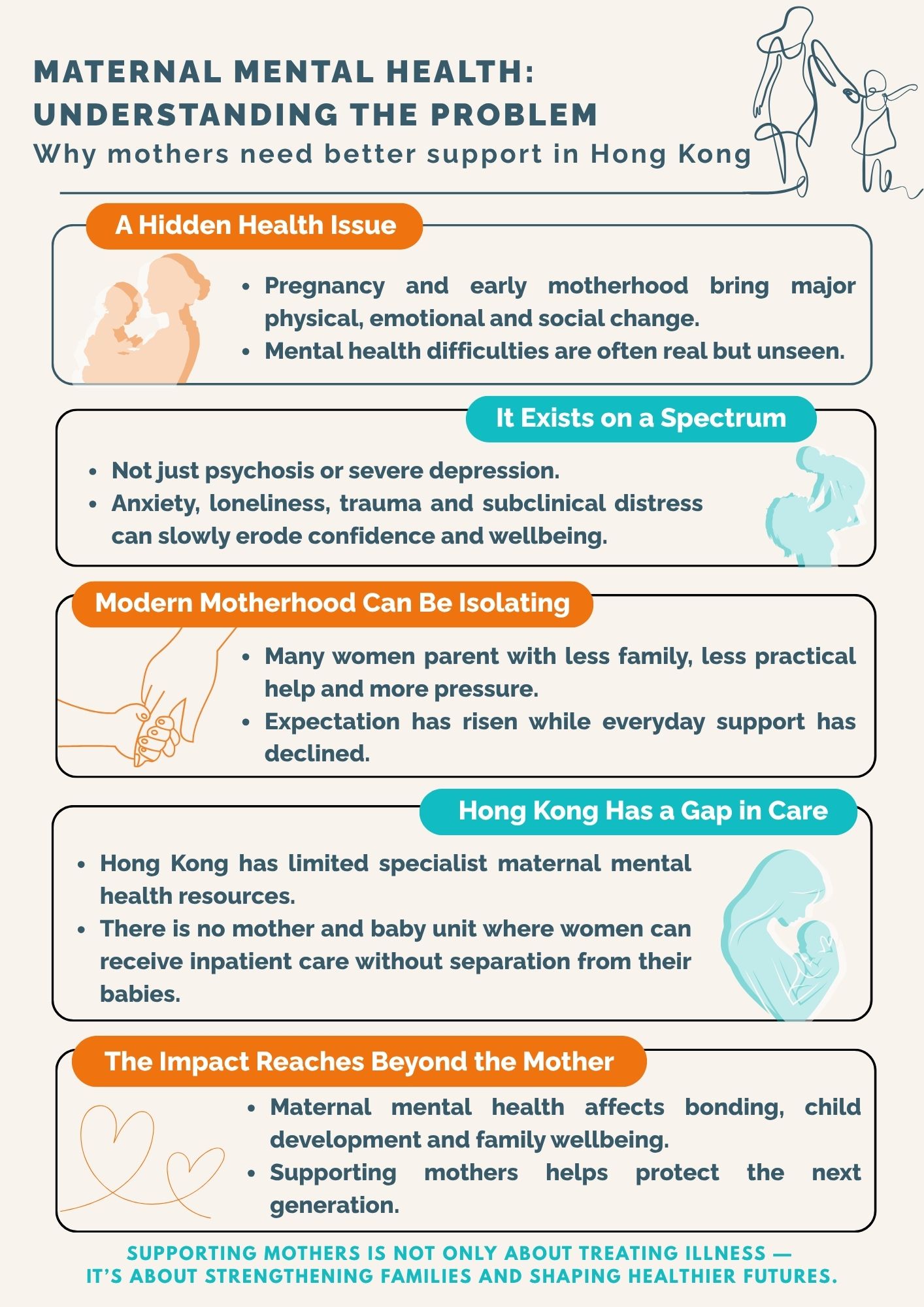
Maternal Mental Health:
Understanding the Problem:
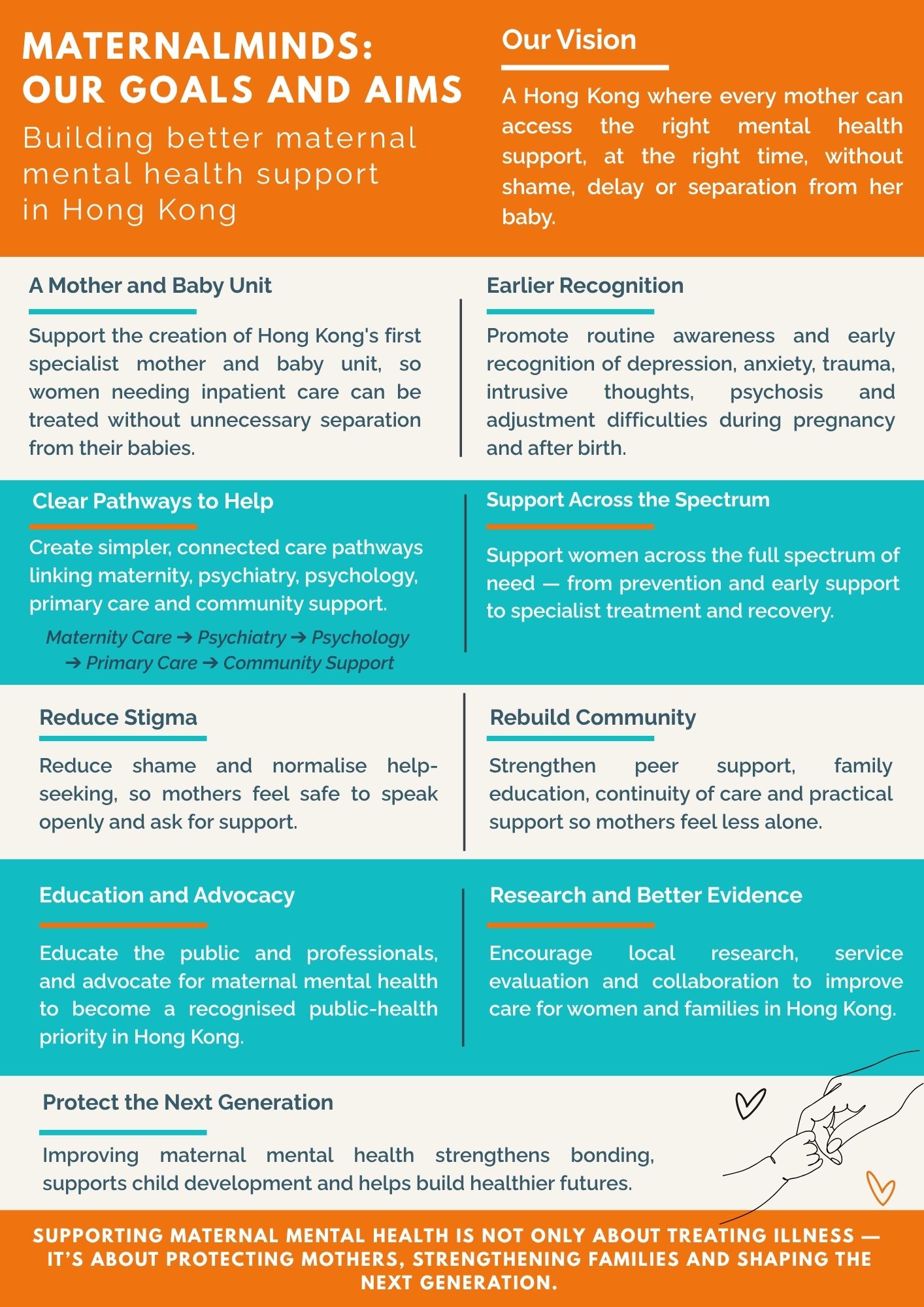
Our Goals and Aims
Support Us
At Mind HK, we believe no one faces mental health challenges alone. But making a change takes a community.
To turn our vision into reality, our immediate mission is to translate 100 pages of the world’s newest, evidence-based maternal mental health materials into Traditional and Simplified Chinese. This localization ensures that life-saving clinical insights and resources are fully accessible to families and healthcare professionals across Hong Kong.
Every single page costs HK$ 1,000 to professionally research, curate, translate, clinically review, license and publish. Your donation will directly fund the localization of vital resources answering critical questions.
- I’m a burnt-out mother, how do I recover?
- Why is the first 1000 days so important?
- What is postnatal depression and anxiety?
- Can I recover from birth trauma?
- When sleep is the symptom, not the problem.
- Do I even have a village anymore, or am I alone?
- I don’t feel an emotional connection with my baby…
- What is reflective functioning in parenting?
- Can you help me? I feel unsafe at home.
- What is puerperal psychosis?